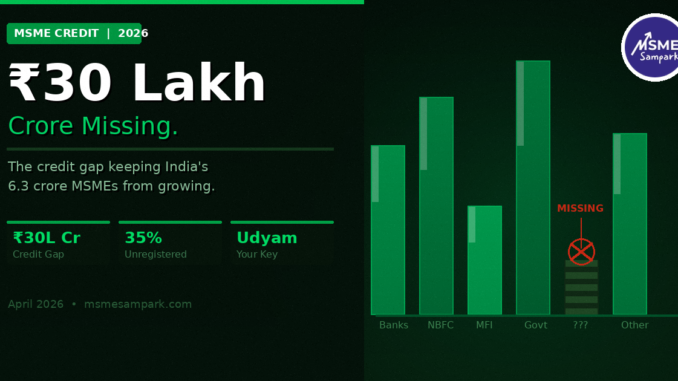
The ₹30 Lakh Crore Credit Gap: Why India’s MSMEs Still Can’t Get the Money They Need April 3, 2026 MSME Sampark Msme News 0 India has 6.3 crore registered MSMEs. They contribute nearly 30% of GDP and employ over 32 crore people. And yet, according to a 2025 SIDBI-Crisil report, the MSME sector faces a credit gap of ₹30 lakh crore. Think about what that means. Thirty lakh crore rupees worth of legitimate business need — working capital, machinery, expansion — that cannot get formal financing. That gap is being filled, partially, by moneylenders charging 3-5% per month. By friends and family loans. By cutting corners on quality, skipping investment, staying small when the business could grow. This is one of the most important economic problems in India. And it does not get enough attention. Why the Gap Exists It is not that banks do not want to lend to MSMEs. The problem is structural. About 35% of MSMEs are completely unregistered and invisible to the formal system. No Udyam number, no GST, no formal books of account. Banks cannot lend to what they cannot see. These businesses exist in a cash economy with no credit history, no verifiable income, and no assets to pledge. Even among registered MSMEs, many run on partially informal books — some transactions in, some out. When a bank asks for 2 years of ITR and 12 months of bank statements, the numbers do not tell the real story of the business. A vegetable oil trader turning over ₹1 crore a month may show ₹30 lakh on paper. The bank sees a small, risky borrower. The reality is a healthy, active business. The third problem is geography. A large portion of India’s MSMEs are in districts where bank branches are sparse, loan officers have little MSME expertise, and the closest NBFC office is a day’s travel away. What the Government Is Doing The policy response in 2025-26 has been reasonably strong: The RBI doubled the collateral-free loan limit to ₹20 lakh from April 2026. The Budget allocated ₹10,000 crore to the MSME Growth Fund for creating “Champion SMEs.” Cabinet approved ₹5,000 crore additional equity for SIDBI in January 2026, which should expand SIDBI’s capacity to lend to and through smaller institutions. The Self-Reliant India (SRI) Fund has already deployed ₹15,442 crore in equity to 682 high-growth MSMEs. These are real numbers. The direction is right. What Is Still Not Working The honest problem is that most of these measures help MSMEs that are already somewhat formal. The business that is already on Udyam, already filing GST returns, already has a bank relationship — they benefit. The truly small, truly informal businesses at the bottom of the pyramid are largely untouched. Additionally, ₹10,000 crore for a growth fund sounds large until you divide it by even one lakh businesses. That works out to ₹10 lakh per business. Useful, but not transformative for someone who needs ₹50 lakh to install a new production line. The deeper fix requires two things the government has been slow to deliver: a functioning credit bureau system that captures informal business activity (using GST data, utility bills, and payment platform data), and a serious push to bring unregistered MSMEs into the formal system without punishing them with tax complexity the moment they register. What You Should Do If You Are an MSME Owner Regardless of policy gaps, here is what is in your control: Register on Udyam if you have not. It is free and opens every government benefit, loan scheme, and legal protection available to you. Build a formal credit history now. Even small loans, repaid on time, build the credit score that determines your interest rate on future borrowing. Use the PSB Loans in 59 Minutes portal (psbloansin59minutes.com) for quick loan approvals based on your GST and ITR data. The credit gap is real. But the tools to cross it — at the individual business level — have never been more accessible than they are right now. bank loansfinancial inclusioninformal creditMSME credit gapsidbiPopular Articles Msme News Covid Period Credit Guarantee Scheme Helped MSMEs Achieve Higher Net Profit Margins: RBI Study IPO News NTPC Green Energy IPO: Special Benefits for NTPC Shareholders and Employees Msme News Filter Capital Invests USD 10 Million in M1xchange to Strengthen MSME Financing Ecosystem Msme News 3,500 Bengal MSME Traders Tap Into Global Markets Through Amazon Msme News New Initiative Launched to Help Indian MSMEs Start Exporting in Just 8 Weeks Msme News Govt Launches ₹5 Lakh Grant Scheme for New MSMEs Msme News Cabinet Approves Integrated Energy, MSME, and Food Processing Policies Msme News India Needs to Bring 80% of MSMEs Under Formal Financial System: M Nagaraju Msme News Centre to Introduce Collateral-Free Loan Schemes for MSMEs: Nirmala Sitharaman Msme News Our Small Businesses Are Growing, But They Still Need a Helping Hand: President Droupadi Murmu on World MSME Day
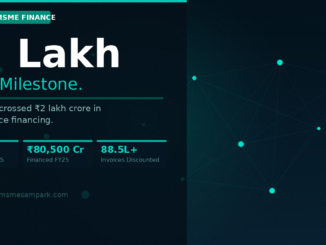
MSME Finance India’s MSMEs Are Finally Getting Paid Faster — TReDS Just Crossed ₹2 Lakh Crore April 22, 2026 MSME Sampark MSME Finance 0 For years, the single biggest complaint from MSME owners across India has been the same: “We delivered the goods. We just can’t get paid on time.” That might finally be changing. The TReDS platform run […]
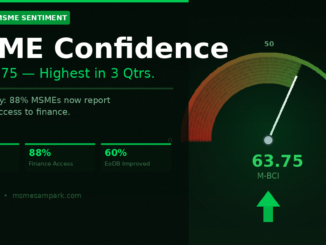
MSME Economy MSME Confidence Is the Highest It’s Been in Three Quarters. Don’t Get Comfortable Yet. April 26, 2026 MSME Sampark MSME Economy, Msme News 0 The Composite MSME Business Confidence Index (M-BCI) — tracked by SIDBI across 1,200 businesses in 15 states — rose to 63.75 in the most recent quarter, up from 60.82 in the previous quarter. That is […]
Msme News Cabinet Approves ₹5,000 Crore Equity Support to SIDBI, PM Modi Calls It a Big Boost for MSMEs January 22, 2026 MSME Sampark Msme News 0 New Delhi: The Union Cabinet has approved a major financial support package of ₹5,000 crore for the Small Industries Development Bank of India (SIDBI), a move that is expected to significantly strengthen credit flow to […]






Be the first to comment