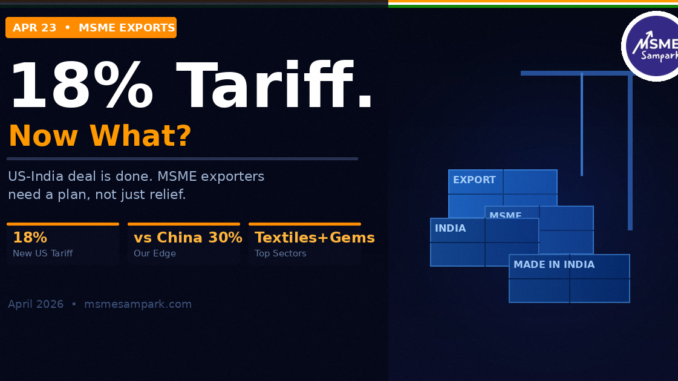
The 18% Tariff Deal Is Done. Now What Do MSMEs Actually Do With It? April 23, 2026 MSME Sampark Msme News 0 By now, most MSME exporters know the headline: India and the US struck a deal in February 2026 that cut the effective US tariff on Indian goods from nearly 50% down to 18%. It was a relief. After months of tariff chaos — orders cancelled, margins crushed, workers laid off in clusters from Tiruppur to Surat — the deal brought some breathing room. But relief is not a strategy. The question now is: what do MSME exporters actually do with this window? What the Deal Changed The US had slapped India with punitive tariffs that pushed effective rates on many Indian goods close to 50% — a combination of a base tariff, a reciprocal tariff, and an extra 25% penalty for India’s Russian oil purchases. The February 2026 deal removed the punitive layer and reduced the reciprocal tariff, bringing the effective rate to 18%. At 18%, India is now more competitive than Vietnam (20%) and significantly better positioned than China (30-35%). That is a real advantage in sectors like textiles, leather, engineering goods, and gems and jewellery — all of which are heavily MSME-driven. The Sectors With the Most to Gain Right Now Textiles and garments from clusters like Tiruppur, Ludhiana, and NCR are the most immediate beneficiaries. US buyers who shifted to alternatives during peak tariff chaos are now looking to rebuild India sourcing relationships. Gems and jewellery — with Surat at the centre — regain pricing viability. Even a 30% tariff difference versus China is meaningful when you’re competing on thin margins. Engineering goods and auto components from SME clusters around Pune, Rajkot, and Coimbatore now have a cleaner cost case for US Tier-1 suppliers who want to diversify away from China. What the Deal Does NOT Fix Be honest with yourself here. The 18% tariff is better, but it is not zero. US buyers are sophisticated — they will ask you to share the tariff burden through lower pricing. That squeezes margins. More importantly, the deal does not solve India’s biggest export problem: documentation gaps, inconsistent quality, and slow response times. American buyers still drop Indian suppliers the moment a shipment is late or a certificate is missing. The tariff window is open. The question is whether you are ready to walk through it. Three Things to Do Now Get your RCMC (Registration cum Membership Certificate) from your export promotion council. Without it, you cannot access government export incentives. List your business on Alibaba, IndiaMART Global, and Amazon Global Selling. US buyers looking to shift sourcing are actively searching these platforms today. Price your products with the 18% tariff already factored in. Do not leave it to the buyer to figure out — show them the landed cost math. That is what serious exporters do. The opportunity is time-limited. Trade deals shift. Be ready now, not later. Popular Articles Msme News MSME Loan Portfolio Reaches ₹64.1 Trillion in FY24: Report MSME Exports India Just Hit a Seafood Export Record of ₹72,325 Crore — And MSMEs Drove Most of It Msme News MSMEs: India’s Biggest GDP Contributor, Says FM Nirmala Sitharaman at IFQM Annual Symposium Msme News Coal Ministry’s 13th Auction Round Opens New Doors for MSMEs in Mining and Allied Sectors Msme News PM Vishwakarma Scheme Brings Skill, Tools & Credit Support Msme News Government Announces ₹10,000 Crore MSME Growth Fund in Budget 2026–27 Msme News FM Nirmala Sitharaman Announces GST Reduction, A Major Relief for MSMEs Msme News Getting Paid Faster Just Got Easier — RBI Is Fixing the TReDS Problem Small Businesses Couldn’t Ignore Msme News Govt. of India Revises MSME Classification Criteria Effective April 1, 2025 Msme News Bihar Disburses ₹2,900 Crore to 74,540 Beneficiaries to Promote MSMEs





Be the first to comment