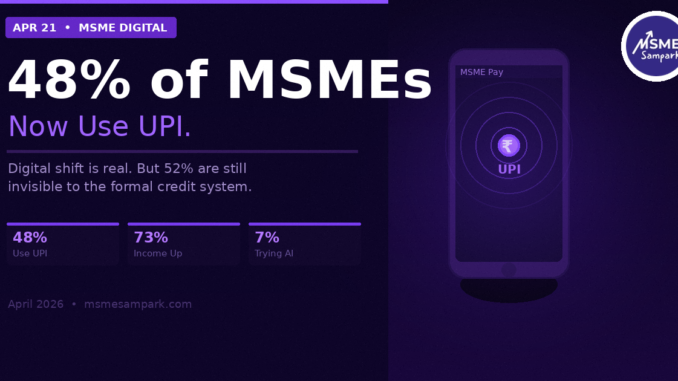
Half of India’s MSMEs Now Use UPI. The Other Half Is Still Paying the Price. April 21, 2026 MSME Sampark MSME Digital 0 A new report from PayNearby just confirmed what many already suspected: nearly half of India’s MSMEs — 48% — have made UPI their primary payment method for business transactions. That is a real shift. Three years ago, most small businesses were running entirely on cash and informal credit. Today, nearly 5 in 10 are transacting digitally, building credit histories, and accessing financial tools that were previously out of reach. But the number that should worry policymakers is the other half. What the Report Shows The MSME Digital Index Report surveyed 10,000 individuals and MSMEs across kirana stores, medical shops, recharge outlets, travel agencies, and customer service points nationwide. Key findings: UPI leads at 48%. Aadhaar-enabled banking is next at 39%. Smartphones are the primary business tool for 71% of users — and for women entrepreneurs, that number jumps to 84%. Over 73% of MSMEs in semi-urban and rural areas said digital tools had increased their income or made operations smoother. The signal is clear: digital adoption is working. MSMEs that use digital payments report real benefits — faster transactions, better record-keeping, access to credit, and increased sales. The 52% Problem Here is the part the headlines miss: 52% of MSMEs are still not using UPI as their primary payment method. Many are still cash-only. And cash-only businesses are invisible to the formal financial system. Banks cannot lend to what they cannot see. An MSME running entirely on cash has no verifiable transaction history, no digital footprint, and no credit score. They are permanently excluded from the formal credit system — not because they are bad businesses, but because they are invisible. This matters enormously given India’s ₹30 lakh crore MSME credit gap. A large portion of that gap exists precisely because half the sector does not generate the digital data that lenders need to assess credit risk. What Needs to Change The government has pushed UPI adoption through merchant incentives and zero-MDR policies. That has worked for the urban and semi-urban segments. The next push needs to target the rural and informal sectors where cash still dominates. For individual MSME owners reading this: if you are not using UPI for business transactions, you are not just leaving convenience on the table — you are making it harder to get a loan, open a business account, and access government scheme benefits. Your digital transaction history is your credit score in the new economy. The shift is happening. But it needs to happen faster, and for everyone. digital paymentsfintechMSME digitisationPayNearbyupiPopular Articles IPO News Western Carriers IPO Allotment Expected on Sep 20: How to Check Status Online, Latest GMP, and Key Details Msme News Andhra Pradesh to Provide ₹100 Crore Credit Guarantee for MSMEs Msme News Chandigarh Set to Boost MSME Sector with 12-Point Development Programme Msme News AI Could Transform MSMEs and Unlock $500 Billion in Economic Value Msme News Odisha’s MSME Sector Embraces Digital Transformation through CII’s Digital Saksham Program Msme News Getting Paid Faster Just Got Easier — RBI Is Fixing the TReDS Problem Small Businesses Couldn’t Ignore Msme News Startup Mahakumbh 2025 is ready to host 3000+ startups in New Delhi Msme News 6.63 Crore Enterprises Registered on Udyam and Udyam Assist Platforms Msme News Delhi High Court: MSMEs Can Claim Benefits Mid-Contract Under MSMED Act Msme News New Incentives for MSME Exporters
Msme News NPCI Rolls Out New UPI Rules from August 1 August 1, 2025 Rahul Singh Msme News 0 New Delhi, August 1, 2025 – The National Payments Corporation of India (NPCI) has officially implemented new operational rules for the Unified Payments Interface (UPI) system starting today. These changes are aimed at enhancing system […]








Be the first to comment