
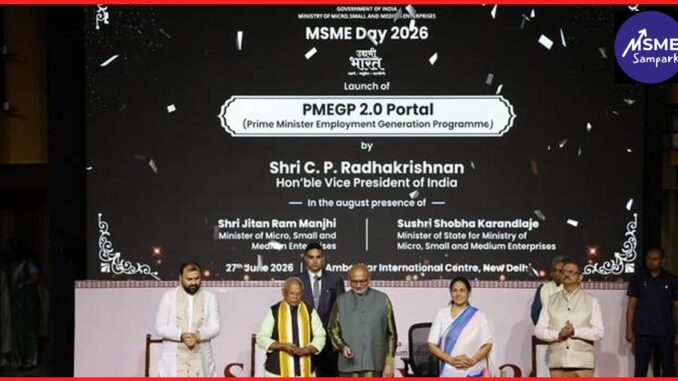
On June 27, 2026, India marked World MSME Day with a sweeping launch of digital platforms, policy upgrades, and a renewed commitment to building a future-ready small business ecosystem.
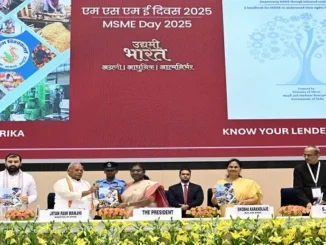
Every year on June 27, India pauses to recognise the engines that quietly power its economy — the micro, small, and medium enterprises that employ hundreds of millions and stitch together the fabric of local commerce from Kashmir to Kanyakumari. This year, World MSME Day carried extra weight. At the Dr. Ambedkar International Centre in New Delhi, the government didn’t just celebrate. It launched a new chapter.
The Ceremony: A Vice President, A Vision
Vice President C. P. Radhakrishnan presided over the flagship ‘MSME Day 2026 – Udyami Bharat’ event, joined by Union Minister for MSME Jitan Ram Manjhi, Minister of State Shobha Karandlaje, KVIC Chairman Manoj Goel, and a gathering of policymakers, industry leaders, women entrepreneurs, and financial institutions. The occasion was more than ceremonial — it was a policy statement made in public.
“If you are determined, nothing can stop you. Every economy in the world has grown through the contributions of the MSME sector.”
— VP C. P. RadhakrishnanThe Vice President, who began his own career with the Coir Board and described himself as a former entrepreneur, brought rare personal texture to a government podium. His words landed not as bureaucratic boilerplate, but as the conviction of someone who has actually navigated the pressures of building something small.
Six Digital Platforms Launched
The centrepiece of the event was the launch of a suite of transformative digital portals designed to reduce friction across the MSME lifecycle — from ideation and funding to testing and grievance redressal:
PMEGP 2.0 Portal — An upgraded interface for India’s flagship credit-linked subsidy programme, the Prime Minister’s Employment Generation Programme, streamlining access for new entrepreneurs.
SAMADHAAN 2.0 Portal — A revamped delayed payment monitoring system to accelerate dues settlement for MSMEs, a perennial pain point for small suppliers.
MSME Global Mart 2.0 Portal — A digital marketplace upgrade aimed at connecting Indian MSMEs with global buyers and strengthening export pathways.
PMS Portal — A performance management system to track outcomes across MSME programmes and schemes.
MSME Testing Portal — End-to-end digitisation of testing activities, enabling sample booking, payment, tracking, and digital test report downloads.
MSME Idea Hackathon 6.0 — The sixth edition of the innovation challenge, offering financial support of up to ₹15 lakh per winning idea through registered Host Institutes.
Languages, Voice, and Inclusion
One of the most significant — and underreported — announcements of the day was the launch of multilingual access across MSME portals. In a country of 1.4 billion people spanning hundreds of languages, government services have historically been most accessible to those who read English or Hindi. That changes now: MSME websites and portals will offer services in all 22 Scheduled Indian languages, powered by BHASHINI and NIC, with AI-enabled voice grievance redressal and document translation built in.
This is the kind of infrastructure decision that rarely makes front pages, but could quietly transform how a weaver in Nagaland or a potter in rural Tamil Nadu interacts with the formal economy.
NSIC Upgraded, Ponduru Khadi Recognised
The Vice President also felicitated the National Small Industries Corporation (NSIC) on its elevation from a Schedule ‘B’ to a Schedule ‘A’ Central Public Sector Enterprise — a recognition of its scale and strategic importance. Separately, Ponduru Khadi from Srikakulam district in Andhra Pradesh received its Geographical Indication (GI) tag, protecting the identity of one of India’s finest hand-spun cotton traditions.
KVIC’s New Products & PM Vishwakarma at Three
The Khadi and Village Industries Commission unveiled a fresh line of eco-friendly products — Tukun (infant wear), Rangtaal (table runners and mats), Bela (infant wrap sheets), Vanya (Eri stoles), and Umang (wool stoles) — blending artisanal craft with contemporary market sensibility.
The event also marked three years of the PM Vishwakarma Scheme, with the release of a Coffee Table Book documenting its impact on traditional artisans — cobblers, carpenters, weavers, blacksmiths — who received recognition, skill training, and access to formal credit for the first time. A book on the Self-Reliant India (SRI) Fund was also released, highlighting its contribution to enterprise growth, employment generation, and women entrepreneurship.
“The MSME sector is the engine of growth of the Indian economy, and entrepreneurs are its drivers.”
— MoS Shobha KarandlajeBeyond Delhi: A Nation-Wide Moment
The celebrations weren’t confined to the capital. In Guwahati, Meta hosted nearly 350 small business owners from across Northeast India — spotlighting how entrepreneurs from the region are building scalable brands using Facebook, Instagram, and WhatsApp, often without large teams or significant capital. Meta noted that over 92% of businesses on its Indian platforms are MSMEs, and that more than 2 lakh small businesses use Click-to-WhatsApp ads every month to find customers.
In Bhopal, Madhya Pradesh Chief Minister Mohan Yadav announced a ₹1,274 crore industry support package at the ‘Sashakt Udyami – Samruddh Madhya Pradesh Summit’, declared 2027 as ‘Youth Year’ in the state, and confirmed that the Global Investors Summit would return to Bhopal in January.
The Larger Picture
India’s MSME sector contributes approximately 31.1% to GDP and accounts for nearly half of all exports. These are not small numbers. But the sector has long struggled with structural challenges — delayed payments, limited credit access, informal operations that exclude entrepreneurs from government benefits, and digital tools that assume literacy in languages many don’t speak.
The announcements of June 27, 2026 don’t solve all of that. But they represent a coherent direction: formalisation through digital infrastructure, inclusion through language access, and innovation through funded hackathons. Whether the portals work smoothly in practice, whether the ₹15 lakh hackathon grants actually reach grassroots innovators, whether SAMADHAAN 2.0 genuinely accelerates delayed payments — that will be the real story, told quietly over the next twelve months.
For now, India’s 7.85 crore registered MSME entrepreneurs have been reminded — loudly, in the capital, by the Vice President — that the government sees them. The question, as always, is whether the government’s attention follows through into their daily ledgers.





Be the first to comment