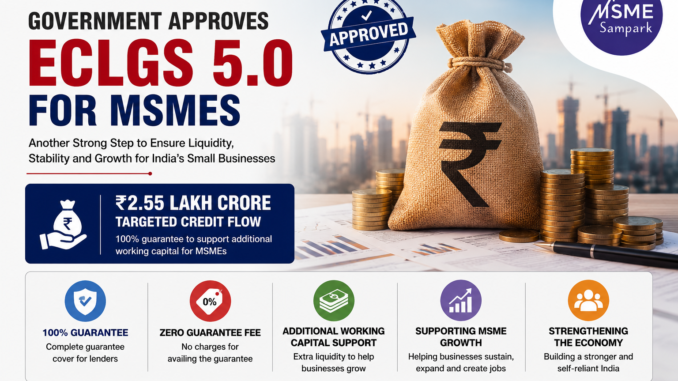
The Government Just Approved Another Lifeline for MSMEs — Here’s Everything You Need to Know About ECLGS 5.0 May 5, 2026 MSME Sampark Msme News 0 When the COVID-19 pandemic hit India’s economy in 2020, one of the government’s fastest responses was the Emergency Credit Line Guarantee Scheme — a programme that allowed small businesses to borrow additional working capital with the government acting as guarantor. It worked. Businesses that would have collapsed kept their staff, kept their suppliers, and kept going. Now, with global economic disruptions creating fresh pressure on India’s small business ecosystem, the Union Cabinet has approved ECLGS 5.0 — the fifth and most ambitious version of the scheme yet. What ECLGS 5.0 Actually Offers Let’s cut through the policy language and explain what this means for a small business owner. 100% guarantee coverage. When a bank lends to an MSME under this scheme, the government guarantees the entire loan. The bank carries zero risk of loss. This matters because the single biggest reason banks hesitate to lend to small businesses is the fear of default. Remove that fear, and lending opens up. Zero guarantee fee. Previous versions of ECLGS charged a small guarantee fee that borrowers had to absorb. ECLGS 5.0 eliminates this entirely, reducing the effective cost of borrowing. ₹2.55 lakh crore targeted credit flow. This is the scale the government is aiming for — a massive injection of working capital into the MSME ecosystem. For context, this is not a loan the government is giving directly. It is a guarantee that enables banks to lend at this scale with confidence. Additional working capital support. The scheme is specifically designed to provide top-up credit to businesses that already have existing loans but need more liquidity to manage operations through difficult periods. Who Should Apply The scheme is aimed at MSMEs — particularly those affected by recent global economic disruptions, including rising input costs, export demand slowdown, and logistics challenges. If your business is registered under Udyam and has an existing credit relationship with a scheduled commercial bank or NBFC, you are likely eligible to explore this. The application process runs through your existing lender. The first step is simply having a conversation with your bank manager about whether your business qualifies under the scheme’s terms. Why This Matters Beyond the Numbers Every time a small business shuts down because of a short-term cash flow problem that a loan could have solved, India loses a job, a family’s income, and often an entrepreneur who will not try again. ECLGS has been one of the most effective tools for preventing exactly that outcome. ECLGS 5.0 is the government doubling down on that logic — and given what MSMEs are currently dealing with, the timing is right. Popular Articles Msme News “India Reduces MSME Payment Delays to ₹7.34 Lakh Crore, But Issues Still Persist” : Report Msme News MSMEs: India’s Biggest GDP Contributor, Says FM Nirmala Sitharaman at IFQM Annual Symposium Msme News MSME Council Proposes Plan to Revive Struggling Small Industrial Units in Odisha Msme News MSME Loan Portfolio Reaches ₹64.1 Trillion in FY24: Report IPO News Kalana Ispat IPO: Strong Demand, Latest GMP, and Subscription Status Msme News Political Parties Look at MSME Sector as Vote Bank Msme News How to Succeed in Business – Insights from Corporate Gifting Expert Shubhanshu Agarwal Msme News Lovejeet Alexander Joins Bloomberg as Director – New Economy; A Proud Mentor of MSME Sampark Community IPO News NTPC Green Energy IPO: Special Benefits for NTPC Shareholders and Employees Msme News Nirman Agri Genetics Sets Board Meeting to Consider Bonus Shares, Dividend, and Expansion Plan






Be the first to comment