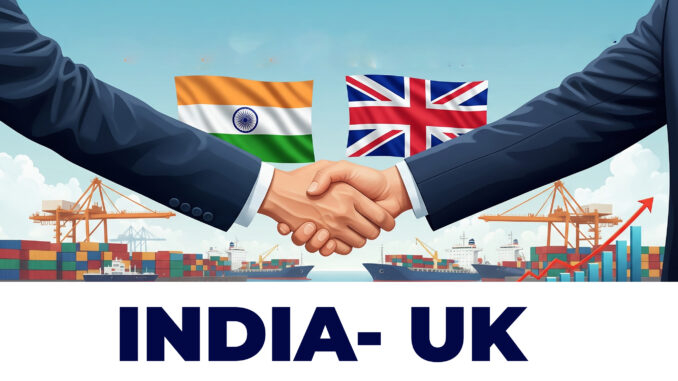
India-UK Free Trade Agreement to Boost Leather and Footwear Exports Beyond USD 900 Million July 29, 2025 Rahul Singh Msme News 0 India’s leather and footwear exports to the United Kingdom are on the brink of a major breakthrough, projected to surpass USD 900 million in the coming years. This growth is largely driven by the India–UK Free Trade Agreement (FTA), which has unlocked new avenues for Micro, Small and Medium Enterprises (MSMEs) across the country, especially in labour-intensive sectors. The FTA provides Indian exporters with duty-free access to the UK’s USD 23 billion market, giving Indian MSMEs a significant advantage over exporters from Bangladesh, Cambodia, and Pakistan. Sectors poised to benefit include leather, textiles and apparel, gems and jewellery, furniture, and sporting goods—many of which are driven by small-scale manufacturers and artisans in India. Beyond the leather and textile industries, the agreement also supports MSMEs engaged in marine products, agriculture, pharmaceuticals, electronics, chemicals, engineering goods, oilseeds, and soft commodities. By enabling better market access and lowering trade barriers, the FTA encourages innovation and enhanced production across these fields. One of the key highlights of the agreement is the strengthening of intellectual property rights (IPR) and geographical indications (GI). This move is expected to improve the global recognition of India’s traditional and unique products, adding commercial value for small producers in international markets. Cities such as Kanpur and Tirupur—hubs of footwear and garment production—are likely to see increased demand for skilled labour, potentially generating thousands of jobs and boosting local economies. Women entrepreneurs, artisans, and craftspeople stand to benefit particularly from the FTA’s inclusive trade provisions. Furthermore, the agreement encourages MSMEs to adopt digital tools, embrace e-commerce, and follow environmentally sustainable production practices. These steps are expected to not only improve operational efficiency but also make Indian products more competitive in the global market. With rising exports, India’s private sector is also expected to ramp up its manufacturing capacity, leading to greater employment opportunities and income growth for workers. Experts suggest that India could soon emerge as one of the top three suppliers of leather, footwear, and textiles to the UK. As India strengthens its position in global trade, the FTA represents more than just an export boost—it signifies economic empowerment for millions of small businesses and artisans nationwide. MSMEs now have a chance to integrate into global value chains, scale up operations, and play a key role in India’s export-led growth journey. Free TradeFree Trade AgreementPopular Articles Msme News India’s Toy Industry Set to Grow Bigger Globally, Says Minister Piyush Goyal Msme News UGRO Capital Plans to Raise $40M to Support Last-Mile Indian MSMEs Msme News Angel Tax Abolition, Boost For MSMEs, and More: How Modi Govt 3.0 is Striving for Ease of Doing Business Msme News PayPal & The Rise of India’s Digital MSMEs Msme News SBI Plans to Increase Threshold Limit Under Instant Loan Scheme for MSME Sector Msme News CM Hemant Soren Places Key Development Demands at Eastern Zonal Council Meeting Msme News PM Modi’s Brazil Visit Opens New Avenues for India–Latin America Trade: FIEO Msme News MSME Sampark x Build Bharat Expo 2025 – Transforming MSMEs, Shaping India’s Future MSME Exports India Just Hit a Seafood Export Record of ₹72,325 Crore — And MSMEs Drove Most of It Msme News NITI Aayog Report Calls for Convergence of MSME Schemes to Improve Efficiency





Be the first to comment