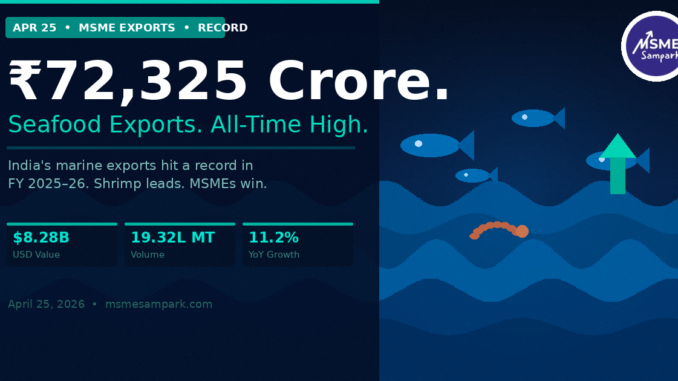
India Just Hit a Seafood Export Record of ₹72,325 Crore — And MSMEs Drove Most of It April 25, 2026 MSME Sampark MSME Exports, Msme News 0 India’s marine products sector just posted its best-ever performance. According to provisional data released by the Marine Products Export Development Authority (MPEDA), India’s seafood exports in FY 2025–26 reached ₹72,325.82 crore — roughly $8.28 billion — with volumes touching 19.32 lakh metric tonnes. That is an 11.2% jump in value over the previous year, and it is a new all-time high. For MSME owners in fisheries, aquaculture, processing, and coastal supply chains, this is a significant headline. But the more important question is: who actually benefits, and what does this mean for small businesses in the sector? Shrimp Is Carrying the Load Frozen shrimp remained the largest export category, generating ₹47,973.13 crore and contributing more than two-thirds of total seafood export earnings, with a 4.6% increase in volume and 6.35% rise in value. That dominance is relevant for MSMEs. Shrimp farming and processing in India is not a large-corporate game. It is predominantly run by small and marginal farmers along the coastlines of Andhra Pradesh, Odisha, West Bengal, Gujarat, and Kerala. Processing units — where shrimp is cleaned, frozen, and packed for export — are mostly small factories employing 20 to 200 workers each. When shrimp exports grow, MSME livelihoods grow with them. The US remained the top export destination at $2.32 billion. This matters in the context of the current 18% tariff environment — at that rate, Indian frozen shrimp remains competitive against Vietnamese and Ecuadorean suppliers. The US-India trade deal signed in February 2026 directly protected this market. Beyond Shrimp — Diversification Working The strong headline hides a wider story. Other products showing growth included frozen fish, squid, cuttlefish, dried seafood, live products, surimi, fishmeal, and fish oil. Chilled products declined — reflecting the logistics pressure from disrupted West Asian shipping routes — but overall diversification held the numbers up. Vizag, JNPT, Kochi, Kolkata, and Chennai together handled nearly 64% of total seafood export value. For MSMEs in these port-adjacent clusters, that concentration means better infrastructure and faster customs clearance — a real competitive advantage compared to exporters in landlocked states. What MSME Owners in Fisheries Should Do Now The government held a Seafood Exporters Meet 2026 in New Delhi and roundtables with diplomats from 39 countries — all aimed at opening new markets. The push toward EU and Southeast Asian buyers is real. If you are a processor or trader currently dependent entirely on the US market, now is the time to diversify your buyer base while the demand window is open. For small shrimp farmers: get your MPEDA registration done. It is mandatory for export eligibility, it is free, and it takes less than a week. Without it, you are selling to a middleman who is taking the export premium that should be yours. This record is good news. The test is whether the next fiscal year builds on it or stalls — and that depends on how aggressively MSMEs in the sector move. Popular Articles Msme News PM Vishwakarma Fair in Ludhiana Attracts Strong Public Response Msme News Uttar Pradesh Launches MICE Incentive Scheme to Promote MSMEs Globally Msme News SBI to Shift to Cash-Flow Based Lending for MSME Loans Up to ₹5 Crore: Chairman Setty Msme News Coimbatore MSMEs Appeal to Government Against Proposed Steel Import Duty Hike Msme News The Digital Pathway to Growth for MSMEs: Unlocking Their Potential in India’s Economy Msme News Government Strengthens MSME Support Through PMEGP and PMMY Msme News MSME Ministry, DPIIT Join Hands to Expand Market Reach of India’s GI Products MSME Economy MSME Confidence Is the Highest It’s Been in Three Quarters. Don’t Get Comfortable Yet. Msme News Commerce Ministry Reports 43% of New White Goods PLI Applicants Are MSMEs Msme News Dr Vivek Bindra Flags MSME Learning Gap as Key Growth Hurdle; Pan-India Entrepreneurs Echo Concern





Be the first to comment